There is a beautiful little settlement on the wild and beautiful west coast of Vancouver Island. I call it a settlement because I don’t think it would qualify as a town. The population when I lived there was the same as my age at the time – eighteen.
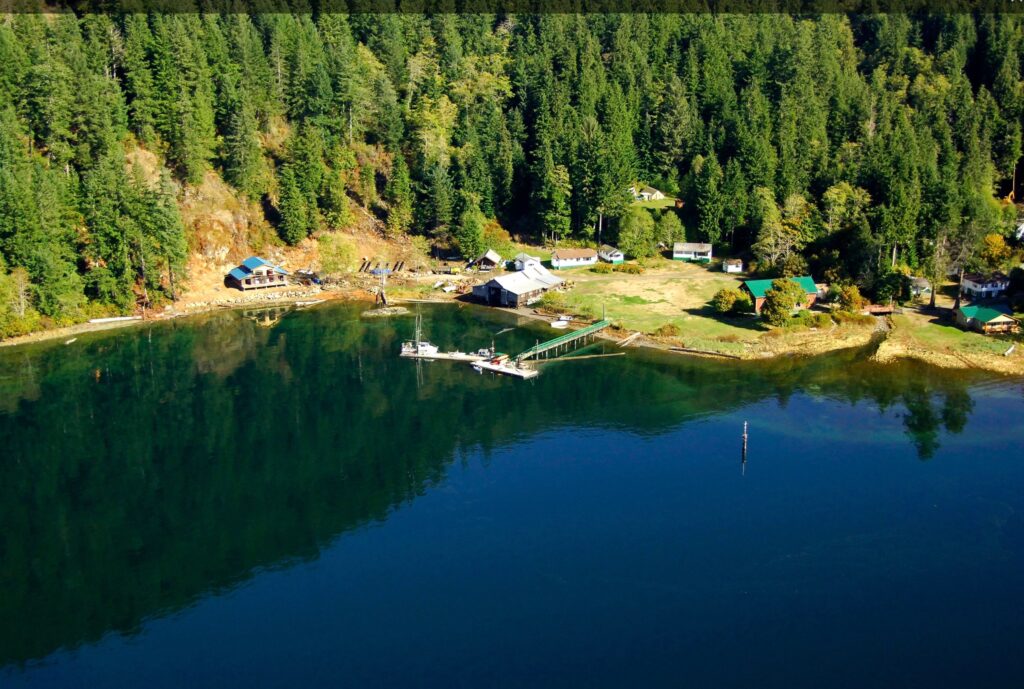
Perched precariously on a tiny stretch of land that couldn’t have been longer than a kilometre, the coastal mountains rose immediately behind it and its front yard grew and contracted with the tide. The only way to reach Esperanza, as it had been beautifully named, was a twenty minute ride by speedboat from the nearest small town. Even that town could only be reached by a two hour car ride over a narrow and twisting logging road.
Screenshot – Found an aerial view online – a couple changes since I was there, but same tiny little oasis!
Neither the word remote, nor idyllic came close to describing Esperanza. Its location had been chosen decades earlier as an ideal spot for a mission hospital that served the coastal populations, most significantly the Nuu-chah-nulth communities.
By the time my family moved to Esperanza the hospital had been replaced by a government hospital in a nearby town. Instead, a marine gas station served fishermen and tourists as they made their way through Nootka Sound. When they stopped for gas they could also come up to a main dining hall to do laundry, have a shower, and enjoy a hot meal with pie lovingly prepared from berries picked on the property by the dining room chef. Other than the gas, no fee was ever charged. It was meant to be a place of peace and warmth for the purpose of showing visitors what the love of Jesus looked like on the precipice of nowhere.
The warmth and welcome of the little team at Esperanza made many visitors dear friends who visited frequently and often brought gifts of their own, furnishing our group with enough seafood of every kind to feed anyone who stopped in.
Among our favourite and most frequent visitors were several indigenous fishermen and their families.
I have moved so many times that I don’t hold people well after moving. Only my fiercest and most tenacious friends stay in my life with any regularity once I leave their locale. It’s not a trait I’m proud of, just a fact.
As a result I have lost touch with absolutely everyone I lived and worked among those two or so years in Esperanza, but one thing I learned has never left me.
When our Nuu-chah-nulth friends were heading out to go home they would invite us to “Come down to the dock and say, See ya.”
That coast was rugged, and the ocean was dangerous. Life lived that remotely had other dangers and discouragements too and there were many deaths even in the short time I lived there. But as a matter of course, we learned not to say goodbye at the end of a visit. We said, See ya.
“See ya” was such a hopeful way to leave a friend or watch their boat disappear out of our little bay. Especially when death was so much more common than in most of the places I called home.
I sincerely long to return to Esperanza. That place leaves a mark like a kiss you never want to wash off. But I will always have a piece of it with me, and it is a part that has learned that, in some of the hardest moments of life, the most perfectly true thing I can say, is see ya.
Like most of us, I have lost people I love to death. As a Christian I believe death is only a physical reality and if we have committed our lives and future to Jesus, we will spend eternity in his presence. Death can take our bodies, but our souls are eternal and those who have chosen Jesus are chosen by him to corporately enjoy his presence in a place where death has no more power even over our physical bodies.
So, only a handful of weeks ago, when I left a hospital bed occupied by someone I dearly loved whose body, we knew, was relinquishing its hold on his spirit, I leaned close to his ear and quietly explained, “I love you. See ya.” And I left that night, and attended his funeral a short time later, believing those words with absolute conviction.
I have been mulling this idea around in my head for years. Every time it is going to be the last time I see someone I love who knows Jesus, the thought returns. It is comforting. Much more, it is hopeful. Best of all, it is true.
In only a couple of days, on Good Friday, we will commemorate the death that made this possible. On Sunday we will celebrate the resurrection from death that made it true.
I can tell you with such confidence, this is not some happy but delusional thought that gets me through the tough days. It is truth.
As Christians celebrate the events we now remember at Easter, do not forget this: We do not mourn as those who have no hope. We live with thankful hearts for the one who first said, See ya, and forever keeps his promises.
Note: If you find yourself wanting to believe this but unsure of its truth, I have written a sort of personal statement of why I believe this is actually historically true. Others have thought about it more deeply and expressed it more eloquently, but if you want to take a look at my thoughts, just go to the menu tab, “Why I Believe”
 The warmth and welcome of the little team at Esperanza made many visitors dear friends who visited frequently and often brought gifts of their own, furnishing our group with enough seafood of every kind to feed anyone who stopped in.